Automobile Leases & Loans
Auto Financing
New and Used Auto Loan Rates
New and Used Auto Loan Rates
Just One Click = Current Rate Chart
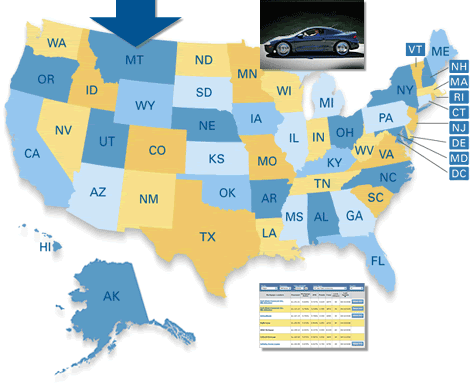
Start by selecting your state
Online car-buying fraud accelerates
by Broderick Perkins
(9/12/2011) - The Federal Bureau of Investigations (FBI) is trying to put the skids on a growing type of cyber scam that's leaving online car buyers fleeced of thousands of dollars and feeling run over.
Other than a home, a car is often the largest single purchase many people complete. They are a necessity and they can be a form of discretionary spending.
There's the practical convenience of door-to-door transit and the status symbol trophy aspect.
But that makes being in the driver's seat a major buyer-beware issue.
Last month, another federal law enforcement agency, the Federal Trade Commission propose tougher regulations on auto dealer loans unwittingly used by eight out of 10 car buyers.
Dealer loans too often come with kick backs that push up the cost of the loan, but at least you get to drive something off the lot.
Get scammed online and you'll still be walking, with a lighter wallet.
Most auto transactions completed on the Internet go off without a hitch.
But those that don't, according to the FBI, work like this:
On a legitimate website, the buyer finds a vehicle he or she likes, often lured by a below-market price.
The buyer contacts the seller, usually via the email address in the online ad, to indicate interest. The seller emails back with a hard-luck story about why they need to sell the vehicle at a bargain price. It's a new military tour in Afghanistan. A family tragedy. A natural disaster. Anything to pull at your heart strings.
The seller asks the buyer to move the transaction to the website of another online company, "for security reasons," and then offers a buyer protection plan in the name of a major Internet company, say eBay or Craigslist.
Through the new website, the buyer receives an invoice and is instructed to wire the funds for the vehicle to an account somewhere. Sometimes the criminals pose as company representatives in a live chat to reassuringly answer the buyer's questions.
Once the buyer foolishly wires the funds, he or she is asked by the seller to fax a receipt to show that the transaction has taken place. Then the seller and buyer agree upon a time for the delivery of the vehicle.
Behind the scenes, what's really happening is the consumer has responded to a phony ad or an ad hijacked from another website. The scammer moves the buyer to a spoofed website where it's easier for the scam to move ahead. The buyer protection plan offered as part of the deal is a bogus come-on.
The buyer is asked to fax the seller proof of the transaction so the crooks know the funds are now ripe for the picking.
By the time the buyer realizes he or she has been scammed, the crooks have hit the road.
While it sounds like even an imbecile wouldn't fall for such a ruse -- buying a car, site unseen and wiring money to a stranger -- the con artists are slick.
The grifter often uses a woman's name, intending to make the seller seem more trustworthy.
The seller cajoles his or her way into the buyer's wallet by offering a low price, by promising to ship the car at no cost, by offering a free protection plan through a known entity and by telling a convincing story of woe and how the car must go.
The seller name drops promising the buyer protection, under auspices of "eBay payment service," "the Carfax escrow service," or "Yahoo buyer protection" -- satisfaction guaranteed. Bogus sellers also promise buyers a week or so to decide if they like the car, after which they are promised they can ship it back, at the seller's expense.
Yeah, right.
Remember, crooks are good at what they do because they do know how to drive a hard bargain.
When buying a car on or offline you have to be smarter. Basic due diligence will make it so.
• First, if it appears to good to be true, duh. Don't be rube. You can't really buy a brand-new Mercedes for $12,000? Snap out of it.
• Forget email transactions. Establish telephone contact with the buyer or seller and determine where the car is located. Demand to inspect the car, and you always should, including having a trusted mechanic give it the once over. Ask if the title is clear. Demand to see the title.
• If you do purchase through an escrow company deposit, again, due diligence. Make sure the escrow company is properly licensed. Call them and speak to a representative. If you are redirected to another Web site, visit it directly, not through a link sent to you by the seller. C'mon. Use your head.
• Never give out private, financial or personal information (Social Security number, credit card number or bank account information) until you verify that the online escrow company you are using is legitimate.
• When a seller insists on using a particular online escrow company, hit the brakes. They could be trying to steer you toward a fraudulent service site. Send the escrow company an e-mail question. If you don't receive a response, don't do business with them. • Be on the look out for sloppy online content, spelling or grammatical errors.
• Be aware of sellers that want you to use person-to-person money transfer services like Western Union or MoneyGram or direct you to send a payment direct to an individual. Legit escrow companies don't.
• Fake escrow company sites often display logos from the Better Business Bureau, VeriSign Secure, TRUSTe, and even the Internet Fraud Complaint Center. Avoid escrow company sites with domain names ending in .org, .biz, .cc, .info or .US and web sites that designate foreign origin. Many of the scams are overseas operations. Again, due diligence. Do your homework. Check to make sure the escrow company really is endorsed by these organizations.
Other related articles:
High MPGs and low auto loan rates can save you thousands of dollars
Research your options when shopping for an auto loan
Shop harder for loans for gas-sipping used cars
How to drive a hard auto loan bargain
Special Report: Hitting the Brakes on Auto Dealer Loans
Get a CLUE about your home and auto insurance claims
Steer clear of car title loans
Driving a hard bargain on car insurance

Automobile Buying/Financing
- Auto Financing
- Automobile Leasing
- Car Buying vs Car Leasing
- 5 Steps to Find the Perfect Car
- 5 Steps to the Perfect Deal
- Closed End or Open End Lease?
- Used Car Buying
- Auto Warranties
- Auto loan defaults to rise 7 percent in 2010
- Auto Show Season Tips for Buyers
- Consumer Reports suspends recommendations for Toyota's recall models
- When is the Best Time to Buy a New Car?
- Making a Vehicle Purchase? Enjoy These Helpful Tips
- Chances are, your next car will be used. Drive a hard bargain
- What your car is really saying
- 2012 President's Day auto sales among best ever
- Special Report: Hitting the Brakes on Auto Dealer Loans
- How to drive a hard auto loan bargain
- Shop harder for loans for gas-sipping used cars
- Auto Insurance
- How Much Auto Insurance
- Buying Ins - Shopping for Insurance
- Best Car Insurance Plan for You
- Car Accident - Filing a Claim
- Auto Ins - Terms & Descriptions
- Driving a hard bargain on car insurance
Top Selling Autos
- Ford F-Series Pickup
- Chevrolet Silverado
- Toyota Camry
- Dodge Ram
- Honda Accord
- Toyota Corolla
- Honda Civic
- Chevrolet Impala
- Nissan Altima
- Honda CR-V
Auto Dealers in Calfornia
- Anaheim
- Bakersfield
- Chula Vista
- Fresno
- Huntington Beach
- Irvine
- Long Beach
- Los Angeles
- Modesto
- Oakland
- Riverside
- Sacramento
- San Bernardino
- San Diego CA
- San Francisco
- San Jose
- San Mateo
- Santa Ana
- Stockton
- Florida Auto Dealers
- ERATE Home