Real Estate Market
Q&A with Karl Lee, President Santa Clara County Association of Realtors
by Broderick Perkins
(8/16/2010) Silicon Valley's housing market is well on its way up, but it still has a long way to go before home values return to peak prices reached back in 2007.
The market's transition prompted us to contact area real estate leaders to gain some market insight for homebuyers and sellers alike.
We recently sat down in a question-and-answer session with Karl Lee, president of the Santa Clara County Association of Realtors (SCCAOR) and a Santa Clara County native.
Lee also serves on San Jose's General Plan Task Force and the San Jose Foreclosure Prevention Task Force and is broker/owner of the family owned Realty World Results Pros in Milpitas.
Lee also has 13 years of experience in corporate banking finance and enjoys softball, volleyball, skiing, hiking and traveling.
Q: How would you describe today's housing market? Is it a buyer's market or a seller's market?
A: Santa Clara County has become a seller's market in 2010. Multiple offer situations have been common. Every month this year has seen 25 to 30 percent increases in closed sales volume compared to the same months last year. We've also seen double digit average sales price increases.
Q: What do today's housing market conditions mean for buyers and for sellers? How can they obtain the best deal, selling or buying in today's market?
A: The current Santa Clara County real estate market has ample opportunities, but buyers and sellers need to be patient and prepare for the unexpected. Closing a contract is more complicated than ever. We have also experienced delays due to the new federally mandated Good Faith Estimate guidelines.
To be a successful seller, you must make strong pricing and presentation efforts to offer the most attractive home on the market. The strategy reveals to buyers that your home is a better value than other homes. It also allows buyers to visualize how the home fits his or her lifestyle.
Buyers in today's market need to understand the competitive environment they face. Buyers need to carefully evaluate homes and contractual terms, particularly when it comes to short sales and bank-owned homes in poor condition or requiring repairs. Buyers must convince sellers that they have most competitive offer and the best chance to close the transaction.
Q: What do you tell buyers who may be waiting for home prices to fall further?
A: I don't sense that prices will fall significantly in our market. However, if prices do fall some, increasing financing costs will likely offset small savings from falling prices.
Q: What do you tell sellers waiting for home prices to rise?
A: Homeowners should base their selling decision on their life goals and lifestyles, not on a projected direction for the housing market. It is impossible to out-plan the market.
Q: Distressed properties account for a larger percentage of homes for sale than normal. These properties can be a good deal, price-wise, for home buyers looking for a bargain. They can also come with hidden problems. How do you advise buyers considering distressed properties?
A: Short sales represent approximately 42 percent of the market, while foreclosed, bank-owned homes represent a much smaller share, approximately 7.72 percent.
My recommendation for buyers is to focus on the best home for their goals and needs. The market perception that distressed properties are bargains has a created a frenzy for these homes and that's created more competition for them, more so than even for traditional listings.
Bank owned sales, short sales and traditional sales each have their own unique set of dynamics and complications which buyers need to consider and adjust to. When it comes to a distressed property, planning for hidden repair costs and legal issues is key.
Q: What's your advice for someone who has an "underwater" mortgage that's larger than the home is worth, but who is not having a problem making payments?
A: History has shown us that our market will work its way out of the current economic cycle. All indications are that we have already hit the bottom. If your lifestyle and goals make sense with your current home, if you can afford to make your payments, you should continue to make your payments.
Q: What's your advice for a homeowner with an "underwater" mortgage but is struggling to make payments or is soon to face a mortgage rate reset or other condition that could cause problems?
A: The first step is to consult appropriate experts including an attorney, a tax expert, a counselor who is certified by the U.S. Department of Housing and Urban Development (HUD) and a realtor. Each homeowner and each loan agreement have unique legal and tax implications.
A great resource for distressed homeowners in Santa Clara County is ForeclosureHelpSCC.org, created by the San Jose Foreclosure Prevention Task Force, a coalition of the City of San Jose, the Santa Clara County Association of Realtors, the Silicon Valley chapter of the California Association of Mortgage Practitioners, a number of HUD certified counselors and other non-profit agencies.
If a short sale is a viable option, experienced realtors with short sale home selling expertise can manage the marketing and contract negotiations.
Q: Given the market has put downward pressure are the value of homes since the peak of the boom, how can homeowners boost home value or shore up and retain the value of their homes?
A: Maintain upkeep, perform repairs, clean up, remove clutter. A home that shines always brings the most value. Home improvements typically don't provide an equal return on the investment, but their true value comes from living and using the improvements.
Paying down and lowering the principal more than what's required by the loan agreement is a good idea, depending upon your lifestyle and financial goals. Of course, the more you pay down the principal, the less mortgage interest you can deduct.
Follow the link to continue reading the related articles
Real estate company satisfaction mixed among buyers, sellers
San Francisco Bay Area ground zero for national housing recovery
California gets $700,000 slice of special $1.5 billion homeowner bailout pie
California home prices shine golden again, sales rusty
Fannie Mae & Jumbo Mortgage Rates
Just One Click! = Current Rate Chart
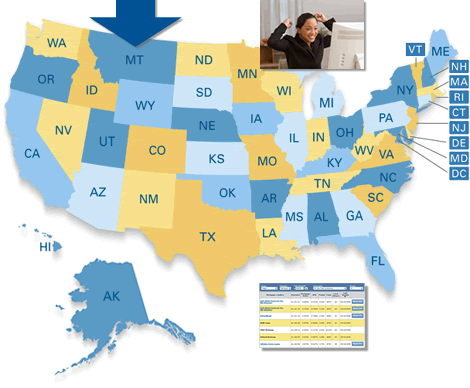
Start by selecting your state

Refinancing: Getting Started
- Refinance at Today's Low Rates!
- Guidelines to Mortgage Refinancing
- Why Refinance Mortgage?
- Would Refinancing Make Sense for you?
- Refinancing: 3 Common Types Refinancings
- Refinancing: Four Mistakes to Avoid
- Mortgage Refinancing Closing Costs Explained
- Potential Tax Benefits
- Mortgage Refinancing Calculator
- Loan Documentation - Mortgage Refinancing
- Refinancing FAQs
- Appraisal when Refinancing
- Refinancing - Non Owner vs Owner Occupied
- Home Owners Litigation - Refinancing
Refinancing: Selecting a Loan
- Mortgage Program Options
- Interest Only Mortgage
- 100% Mortgage Financing - No Down Payment
- No Costs Mortgage Refinancing
- 2% Rule - Refinancing Mortgage
- Yield Spread Premium
- Zero Costs Mortgage Refinancing
- Prepayment Penalty - Mortgage Refinancing
- What is APR and how is it calculated?
- Current Refinance Rates
- Private Mortgage Insurance - Refinancing
FREE Mortgage Rate Widgets
Your State's Rates or National Rates Get this Widget for any State you want