Option ARM - Option Adjustable Rate Mortgage
Mortgage Programs
Option-ARMs:
The Loan Banks Wish They Had Opted Not to Do
by Nancy Osborne, COO of ERATE®
The mortgage known as the option-ARM has been rapidly gaining momentum as the most troubling of all mortgages. Option-ARMs are producing a greater number of delinquencies and foreclosures than even loans within the sub-prime category. Although they account for a much smaller percentage of the total population of mortgages, when compared with sub-prime, option-ARMs appear to be far more problematic on a lender's balance sheet. While the rate of default seems to have stabilized in the sub-prime loan category, the trouble with option-ARMs may only be gaining steam as the cycle of interest rate re-sets is just beginning. One million option-ARMs are on tap to re-set over the next four years and those loans appear to be heavily concentrated in areas which have proven to be hardest hit by the housing crisis, increasing their exposure and risk to falling property values. Options-ARMs comprise almost 40% of loans which are delinquent by 60 days or more in both Florida and Nevada and account for 28% of similar delinquencies in California and 20% in Arizona.
Commonly referred to within the mortgage industry as “pick-a-pays” these adjustable rate loans were primarily written for credit-worthy borrowers who wanted to control their monthly cash-flow by being given a variety of payment options to choose from. However, over half of option-ARM borrowers have opted only to make their required minimum monthly payment, as has been the characteristic of option-ARM borrowers traditionally. The tidal wave of re-setting option-ARMs looming on the horizon could serve to undermine a potential recovery in the housing market. Lenders, who could be faced with a flood of loan modification requests from soon-to-be re-setting option-ARM borrowers, must consider if a rate reduction, coupled with a principal reduction, along with an extended loan term might not even be enough to turn things around. Because many of these mortgages began with interest rates as low as 1%, there isn't much room left to improve upon the rate now. Many option-ARM loans seem likely to fall into foreclosure as so many of the loans were structured to permit deferred interest (or negative equity) of up to 125% of the original loan amount. The resulting amount of negative equity which has accumulated makes it unlikely that option-ARM borrowers would have the ability to refinance into any of the programs currently available. Is it possible that some option-ARM borrowers may decide that their best option now may be to walk away?

ERATE was warning the public about the Dangers of Option ARMS in 2005.
Here is a quote from Bloomberg / Business Week made by Keith Schemm representing ERATE.
Be especially cautious of markets in which option adjustable-rate mortgages are hot. These loans offer borrowers extremely low teaser rates -- typically, just 1% for the first month -- and allow the option of making a minimum payment that may not even cover all of the interest owed for the month. The unpaid interest gets added to the principal, so the total owed can swell like a credit-card bill. Borrowers may be enticed by the introductory rate but unprepared for later payments on the swollen principal. Keith M. Schemm, a mortgage broker in Santa Clara, Calif., says option ARMs are "pretty dangerous loans to do" for many families. "The problem is there's such a frenzy in the marketplace to buy a home."
Fannie Mae/Freddie Mac
Conforming Mortgage Rates
Just One Click = Today's Rates
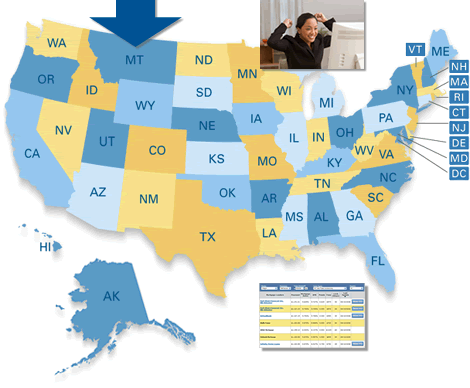
Start by selecting your state
To learn more about Option ARMs, visit the Federal Reserve Board's site: “Interest-Only Mortgage Payments and Payment-Option ARMs: Are they for you?”
http://www.federalreserve.gov/pubs/mortgage_interestonly/
 Nancy Osborne has had experience in the mortgage business for over 20 years and is a founder of both ERATE, where she is currently the COO and Progressive Capital Funding, where she served as President. She has held real estate licenses in several states and has received both the national Certified Mortgage Consultant and Certified Residential Mortgage Specialist designations. Ms. Osborne is also a primary contributing writer and content developer for ERATE.
"I am addicted to Bloomberg TV" says Nancy.


- Option ARM - Optional Payment Adjustable Rate Mortgage - Overview
- Option ARMs The Loan Banks Wish They Had Opted Not to Do
- Option ARM - 1 Month Option Adjustable Rate Mortgage
- Option ARM Program Highlights and Guidelines 1-, 3-, 6- and 12-Month Option ARMS
- Option ARM Program Highlights - Hybrid ARMS - Flex 3 and Flex 5
- Click here for Current Mortgage Rates